
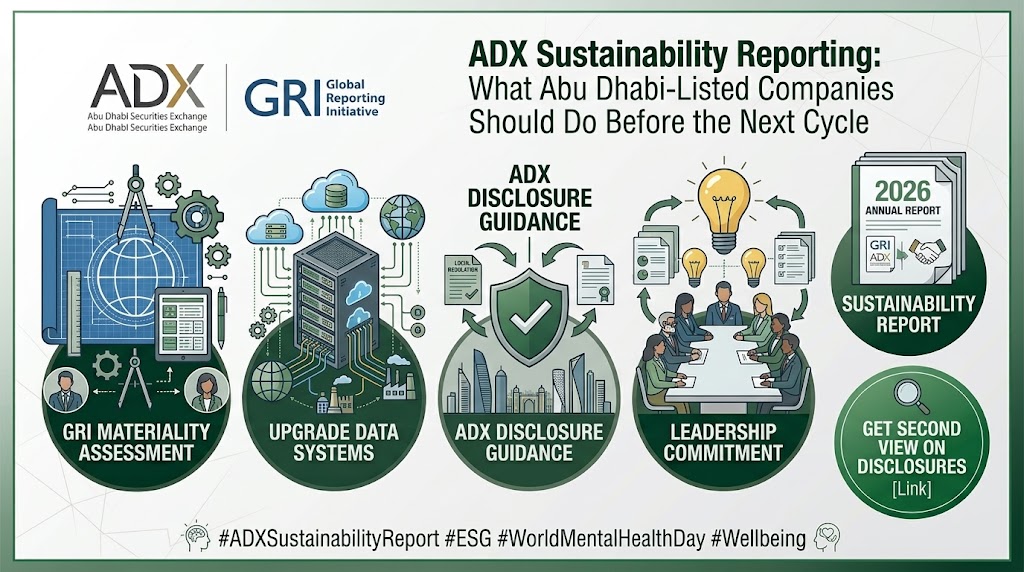
The annual report is filed. The AGM is behind you. And then a question lands in your inbox that nobody planned for: “Is our ESG disclosure actually in line with what ADX expects, or did we just meet the filing deadline?“
It’s a fair question, and a quietly uncomfortable one. Meeting a deadline and meeting an expectation are not the same thing, and in sustainability reporting the gap between them is where most of the avoidable stress lives. If you’ve been wondering where that gap is for your own company, this guide is for you.
We covered the full UAE picture in our UAE regulatory ledger on SCA, ADX, DFM and Decree No. 11. This follow-up zooms in on one exchange and one question: what does ADX sustainability reporting look like in practice, and what should a listed company do about it?
First, how ADX fits into the bigger picture
Two things sit side by side, and they are easy to blur together.
The first is a legal requirement. Under SCA’s Corporate Governance Code (Article 76, Decision No. 3/R.M. of 2020), public joint stock companies listed on ADX or DFM must publish an annual sustainability report and file it with SCA, within 90 days of financial year-end or before the annual general assembly, whichever comes first.
The second is guidance. The ADX ESG Disclosure Guidance tells ADX-listed companies how to structure what they disclose. ADX first issued it in July 2019, and the version on ADX’s website today is dated June 2025. It describes itself as a voluntary guide.
So SCA says that you report. ADX helps with how. Keeping those two apart is the first step toward not being surprised.
What the ADX ESG disclosure guidance actually asks for
The guidance is organised into environmental, social and governance metrics, plus a short set of integrated metrics covering reporting, ratings and stakeholder engagement. Here is what that looks like in plain terms:
- Environmental: operations, energy, emissions, water, waste, and how climate risk is governed and managed.
- Social: pay equity, turnover, diversity, labor practices, health and safety, and community investment.
- Governance: board structure, ethics, data privacy, sustainability strategy, risk management and disclosure practices.
A few details in the current version are worth knowing before you plan your next cycle:
- It points companies toward the IFRS Sustainability Disclosure Standards (IFRS S1 and S2) and GRI, alongside the Sustainable Stock Exchanges Initiative and World Federation of Exchanges recommendations.
- On materiality, it says a topic counts as material if it meets the test for impact materiality, financial materiality, or both. That is a wider door than a purely investor-focused lens.
- It expects ESG data to follow the same annual rhythm as your financial reporting.
- It encourages third-party assurance, on the grounds that it reduces data quality risk and builds credibility. Encourages, not requires.
If your last report was built against the 2019 version of the guidance, it is worth re-reading the current one line by line. The goalposts have moved, quietly.
“Voluntary” does not mean “optional”
This is the part we hear misunderstood most often, so let’s say it gently and clearly.
Technically, nobody can fine you for ignoring a voluntary guide. But your report is not read by a lawyer checking boxes. It is read by an institutional investor’s analyst, a lender running a climate-risk screen, or a procurement team deciding whether to keep you on their supplier list. They are comparing you with other ADX-listed companies. If peers follow the exchange’s structure and you don’t, the difference is visible within minutes, and it raises questions you did not intend to invite.
In practice, ADX ESG reporting works like a shared language. Using it well signals that you take disclosure seriously. Ignoring it makes the reader work harder to understand you, and readers rarely give that effort twice.
How ADX guidance, GRI and IFRS S1/S2 fit together
Many teams treat these as three separate projects. They are closer to three views of the same body of work.
- GRI is about your impact on people and the environment. If you want the full picture, we’ve written it up in our GRI Standards guide for UAE and Qatar businesses.
- IFRS S1 and S2 are about the sustainability and climate information an investor needs to judge financial risk. Our IFRS S1 and S2 reporting guide explains where each standard is mandatory today and where it is not.
- The ADX guidance sits on top of both, giving you a structure and a set of metrics that match what the exchange and its investors expect to see.
The practical upside is that the stakeholder conversations, governance records and data pipelines you build once serve all three. The practical downside, if you build them separately, is doing the same work three times in the weeks before a deadline.
Four patterns we see in ADX-listed companies
None of these are failures of effort. They are what happens when a small team carries a large reporting job.
- Writing the report backwards. Teams start from the metric list and fill in numbers, and only later ask which topics were material. A materiality assessment that came after the report is hard to defend.
- Treating the sustainability report as the finance team’s side project. Emissions, HR and safety data sit in different systems with different owners. Without a clear owner for each metric, the collection scramble repeats every year.
- Overstating governance. Describing a sustainability committee that exists on paper but rarely meets does more damage than describing a younger setup candidly.
- Ignoring Scope 3 until someone asks. It is the hardest category to measure, and increasingly the first thing a serious investor or buyer asks about.
If any of these sound familiar, that is not a verdict on your team. It is a signal about where the process needs support.
If you also operate in Qatar or across the GCC
Many ADX-listed groups have subsidiaries, clients or lenders in Qatar, and the rules there are structured differently: three regulators with three different postures. Our Qatar ESG regulatory landscape explainer walks through QFMA, QSE and QCB, so you can plan one reporting process that holds across borders instead of rebuilding it for each one.
A calm checklist for your next ADX reporting cycle
You do not need to do all of this at once. Pick the first item that feels uncomfortable and start there.
- Re-read the current ADX ESG Disclosure Guidance and mark which metrics you can already report with confidence.
- Confirm your materiality assessment is current, documented, and based on real stakeholder input.
- Assign a named owner to each data point, with a source system and a review date.
- Map your SCA filing date backwards: a December year-end means a 31 March deadline, so data collection should start in the last quarter, not after year-end.
- Decide whether limited assurance is worth adding this year, and if not, what would make it worth adding next year.
- Check how your disclosures line up with IFRS S1 and S2, even if no regulator has required them of you yet.
FAQ:
Is ADX sustainability reporting mandatory?
Filing an annual sustainability report with SCA is mandatory for public joint stock companies listed on ADX, under Article 76 of SCA’s Corporate Governance Code. The ADX ESG Disclosure Guidance, which tells you how to structure that report, is described by ADX as voluntary, though investors increasingly treat it as the expected standard.
What is the ADX ESG Disclosure Guidance?
It is ADX’s guide for listed companies on what ESG information to disclose. It covers environmental, social and governance metrics plus integrated metrics, and was first issued in 2019 and updated since. The version currently published on ADX’s website is dated June 2025.
Does ADX require IFRS S1 and S2?
The current guidance points listed companies toward IFRS S1 and S2 alongside GRI and regional metrics, but it is a voluntary guide, not a binding adoption of the standards. For where IFRS S1/S2 is binding today, see our IFRS S1 and S2 guide linked above.
When is the ADX sustainability report due?
SCA requires the report within 90 days of financial year-end or before the annual general assembly, whichever is earlier. For a 31 December year-end, that is 31 March.
Do we need external assurance for our ADX ESG report?
Not as a requirement. The ADX guidance encourages third-party assurance because it strengthens data quality and credibility, and many companies add it once their processes are stable.
Can a private company in Abu Dhabi use ADX’s guidance?
Yes. It is written for listed companies, but private businesses increasingly use it as a benchmark when banks, investors or larger customers ask for ESG information.
Talk to an ESG reporting consultant in Abu Dhab
If you are an ADX-listed company, or a business preparing for the questions that come with one, the most useful first conversation is a quiet one: where do you stand today against the SCA requirement, the ADX guidance and the frameworks sitting alongside them, and what would it take to close the gaps well before the next deadline?
The One Percent works with companies across the UAE and Qatar on exactly that. Book a Free Compliance Assessment and we’ll map your position against SCA, ADX, GRI and IFRS S1/S2, so your team collects data once and reports with confidence.
This article is for general information and does not constitute legal advice. Requirements referenced are current as of publication; always confirm obligations and the current version of the guidance directly with SCA, ADX, or a qualified advisor.