
Most pages on IFRS S1 and S2 explain the standards in the abstract — governance, strategy, risk management, metrics and targets — without ever answering the question that actually brought you here. “What does this require of my company, in my market, on what timeline” is a different question from “what is IFRS S1/S2,” and most of what’s published only answers the second one.
This is the page that answers the first.
What IFRS S1 and S2 actually require
Both standards, issued by the International Sustainability Standards Board (ISSB), are built around the same four-pillar structure – deliberately mirrored on the TCFD framework so companies already doing climate risk disclosure aren’t starting from zero:
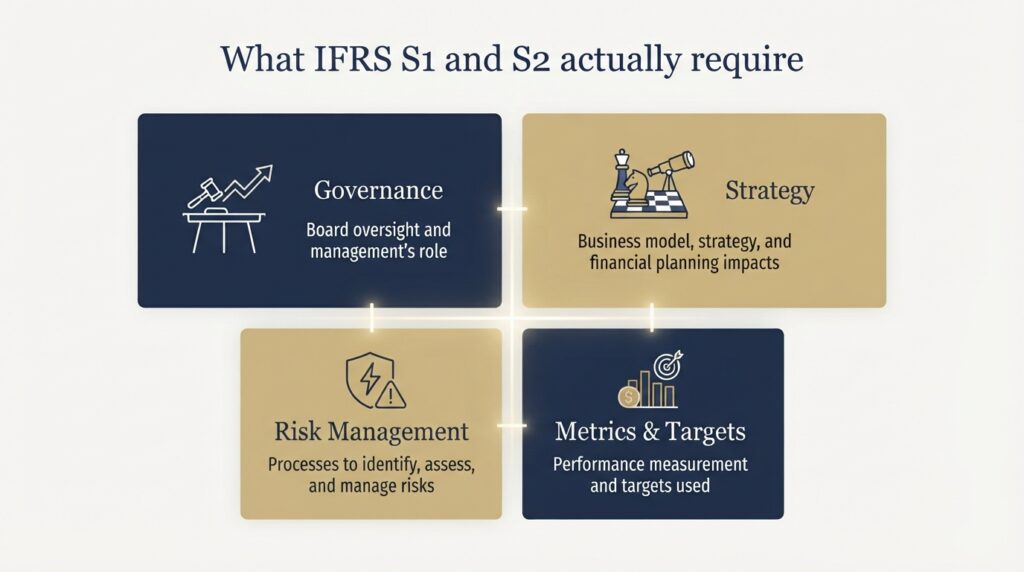
| Pillar | What it covers |
|---|---|
| Governance | The processes, controls, and procedures used to monitor, manage, and oversee sustainability and climate-related risks and opportunities |
| Strategy | The company’s approach to managing those risks and opportunities, and their effect on business model, strategy, and cash flows |
| Risk Management | How the company identifies, assesses, prioritizes, and monitors sustainability and climate-related risks |
| Metrics and Targets | Performance against sustainability and climate objectives, including progress toward any targets set |
IFRS S1 is the general-purpose standard – it covers sustainability-related risks and opportunities broadly, using a financial materiality lens: information gets disclosed if it could reasonably be expected to affect the company’s cash flows, access to finance, or cost of capital over the short, medium, or long term. That’s a narrower test than “anything an NGO might care about” – it’s specifically about what a lender or investor needs to make a resource-allocation decision.
IFRS S2 narrows in on climate specifically, and adds real teeth: physical risk and transition risk disclosure, Scope 1 and Scope 2 greenhouse gas emissions as a baseline requirement, and – for most companies – Scope 3 (value chain) emissions as well, since that’s usually where the largest and most material climate exposure actually sits. IFRS S2 has been in effect for annual reporting periods beginning on or after 1 January 2024 as an ISSB standard; what varies by jurisdiction is not the standard itself, but whether a local regulator has made it mandatory yet.
That “whether” is exactly where UAE and Qatar currently diverge – and it’s the part most explainers skip.
Qatar: mandatory for financial institutions, directional for everyone else
Qatar is currently the more advanced of the two markets on IFRS S1/S2, but the mandate is narrower than a lot of summaries suggest – it’s landed on the financial sector first, through two separate regulators, not on listed companies broadly.
QCB (Qatar Central Bank) issued its Sustainability Reporting Framework (SRF) on 4 December 2025, built directly on IFRS S1 and S2. It’s mandatory for every bank and insurance company QCB licenses, listed or not. Implementation began 1 January 2026, with the first report – covering FY2026 data – due in 2027.
QFCRA (Qatar Financial Centre Regulatory Authority) – a separate regulator from QCB, overseeing firms registered in the Qatar Financial Centre free zone – moved on a parallel track. Its Corporate Sustainability Reporting Rules 2025 came into force by year-end 2025, also built on IFRS S1/S2, and apply to QFC-authorized Category A firms (banks and insurers) plus any firm the QFCRA specifically designates. The rules run to roughly 83 pages of guidance, including how the regulator treats reports built to ISSB-aligned local standards rather than the ISSB text verbatim.
QFMA and QSE, by contrast, have not yet mandated IFRS S1/S2 specifically for QSE-listed companies. QFMA’s 2025 Governance Code makes ESG disclosure mandatory for listed companies, and QSE’s guidance covers 34 KPIs aligned with GRI, TCFD, and the GCC’s regional metrics – but the move to a full ISSB/IFRS S1-S2 mandate for the exchange’s listed companies broadly is a signaled direction, not yet a confirmed rule with a fixed date.
In short: if your company is a QCB-licensed bank or insurer, or a QFC-registered Category A firm, IFRS S1/S2 reporting is already mandatory, with a real deadline attached. If you’re QSE-listed outside the financial sector, it isn’t mandatory yet – but it’s the direction every signal points, and building toward it now avoids a scramble later.
UAE: no mandatory date yet – but the runway is shorter than it looks
The picture in the UAE is less advanced on paper, but arguably higher-pressure in practice. As of the most recent available guidance, no UAE regulator – SCA, ADX, DFM, ADGM, or DIFC – has announced a mandatory adoption timeline for IFRS S1 or IFRS S2.
That doesn’t mean nothing is happening. SCA has required sustainability disclosure from listed public joint stock companies since 2020, under Article 76 of its Corporate Governance Code, and ADX and DFM have each published ESG guidance since 2019. But those existing mandates were built on GRI, TCFD, and the Sustainable Stock Exchanges Initiative’s core metrics – not on IFRS S1/S2, which didn’t exist yet when those guides were written. Both exchanges are known to be updating their guidance to move toward ISSB alignment, but as of now, that’s an evolution in progress rather than a confirmed rule with a date attached.

What’s genuinely moving faster than the regulatory text: market adoption. A number of UAE-listed entities have already started referencing the ISSB standards directly in their 2024 sustainability reports – running materiality assessments and structuring disclosures to be broadly consistent with IFRS S1/S2, ahead of any legal requirement to do so. That’s a meaningful signal for two reasons. First, it suggests UAE regulators are likely to formalize a mandate once enough of the market has already moved (the same pattern seen in Qatar, where the financial sector moved first and pulled the rest of the market’s expectations along with it). Second, it means voluntary IFRS S1/S2 alignment is quietly becoming a competitive and investor-relations signal in its own right – a company that’s already there looks materially more prepared than one that isn’t, regardless of what the law technically requires this year.
In short: if you’re a UAE public joint stock company, there’s no IFRS S1/S2 deadline on the calendar yet – but there’s also no signal that “wait until there’s a mandate” is a safe strategy, given how quickly the region’s other markets have moved from voluntary guidance to binding rule.
Side-by-side: where each market actually stands
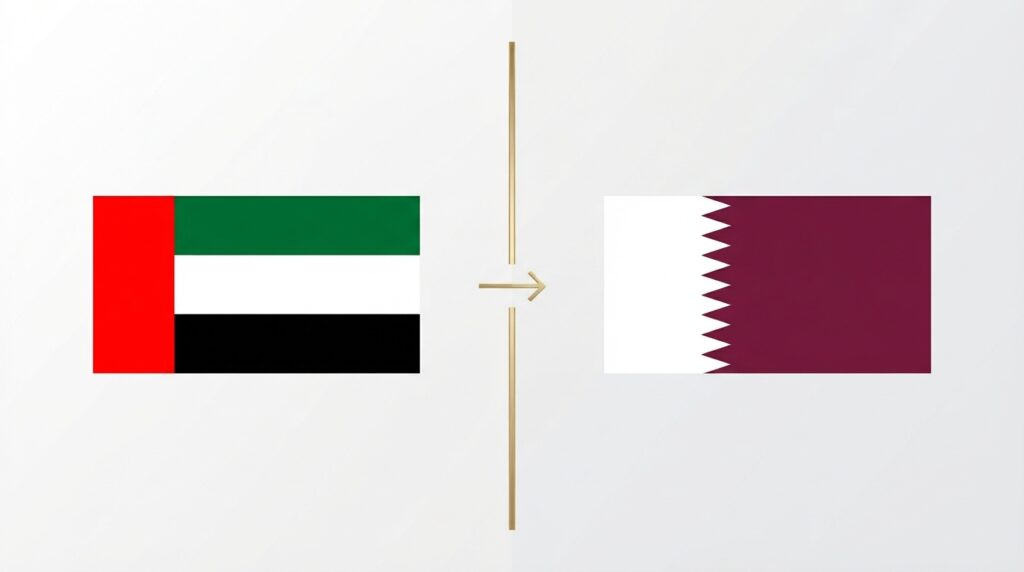
| UAE | Qatar | |
|---|---|---|
| Mandatory IFRS S1/S2 today? | No – no confirmed date from SCA, ADX, DFM, ADGM, or DIFC | Yes, for QCB-licensed banks/insurers and QFC Category A firms; not yet for QSE-listed companies broadly |
| Existing sustainability mandate | SCA Article 76 (since 2020); ADX/DFM ESG guidance (since 2019), built on GRI/TCFD/SSE metrics | QFMA Governance Code (2025); QSE’s 34-KPI guidance, built on GRI/TCFD/GCC metrics |
| Direction of travel | Exchanges updating guidance toward ISSB alignment; voluntary early adoption already visible in 2024 reports | Financial sector already mandated; listed-company mandate signaled but not yet dated |
| Who’s exposed first | Companies voluntarily benchmarked against ISSB by investors, even without a legal mandate | QCB-licensed banks/insurers (now); QFC Category A firms (now); QSE-listed companies (later, direction unconfirmed) |
What this means if you’re not sure where you stand
Whether or not IFRS S1/S2 is legally mandatory for your business right now, three groups should be building toward it deliberately rather than waiting for a deadline to force the issue:
- QCB-licensed banks and insurers, and QFC Category A firms – this isn’t optional. The SRF and the QFCRA rules are live, with FY2026 data already the reporting baseline.
- QSE and UAE-listed companies – the mandate isn’t confirmed yet, but every regional signal (Qatar’s financial sector, both exchanges’ own guidance updates) points toward IFRS S1/S2 becoming the baseline within the next reporting cycle or two. Building the governance structure, data architecture, and materiality process now is materially cheaper than retrofitting it under a compliance deadline later.
- Any company being asked by a bank, investor, or larger client for climate or sustainability data – increasingly, the request itself is shaped by IFRS S1/S2’s structure, even when the company asking isn’t legally required to use it. Being able to answer in that format, rather than translating from something else, is what actually gets the conversation moving.
The work is the same either way: board-level oversight of sustainability and climate risk, a real risk-identification and materiality process (not a retrofit exercise the week before a report is due), a defensible baseline for Scope 1 and Scope 2 emissions with Scope 3 in view, and data systems that can produce the numbers on a recurring, auditable basis – not a one-time collection exercise.
Frequently Asked Questions:
-
Is IFRS S1/S2 reporting mandatory in the UAE?
Yes, IFRS S1/S2 reporting is mandatory in the UAE for companies listed on the Abu Dhabi Securities Exchange and Dubai Financial Market.
-
Is IFRS S1/S2 reporting mandatory in Qatar?
Yes, for specific entities. The Qatar Central Bank’s Sustainability Reporting Framework, effective 1 January 2026, mandates IFRS S1/S2-based reporting for every bank and insurer QCB licenses. The QFC Regulatory Authority’s Corporate Sustainability Reporting Rules 2025, in force by year-end 2025, mandate it separately for QFC-authorized Category A firms. It is not yet mandatory for QSE-listed companies outside the financial sector.
-
What’s the difference between IFRS S1 and IFRS S2?
IFRS S1 is the general sustainability disclosure standard, covering any sustainability-related risk or opportunity that could reasonably affect a company’s cash flows, financing access, or cost of capital. IFRS S2 is climate-specific, adding requirements for physical and transition climate risk, and Scope 1, 2, and (for most companies) Scope 3 greenhouse gas emissions.
-
Do private, unlisted companies need to worry about IFRS S1/S2?
Not directly in most cases, unless they’re a QCB-licensed bank, insurer, or QFC-registered Category A firm. But private companies increasingly face IFRS S1/S2-structured data requests from banks, investors, and larger corporate clients, making familiarity with the framework a practical business concern even without a direct legal mandate.
-
What should a company do if IFRS S1/S2 isn’t mandatory for it yet?
Build the underlying capability now rather than waiting for a deadline: board-level governance over sustainability and climate risk, a genuine materiality assessment process, a credible Scope 1/2 emissions baseline with Scope 3 visibility, and data systems that can produce auditable numbers on a recurring basis. Regional momentum – Qatar’s financial sector mandate and both UAE exchanges updating their guidance – suggests the window before a formal mandate arrives is shorter than it currently appears.
Where The One Percent (D1Percent) fits
This is exactly the gap we work in – bridging where a company sits today against where IFRS S1/S2 is heading, in both the UAE and Qatar. We build GRI and ISSB-aligned sustainability reports designed to hold up under real scrutiny now, and to extend cleanly into full IFRS S1/S2 disclosure the moment a mandate lands, a company lists, or a lender starts asking questions structured around the standard.

Not sure whether IFRS S1/S2 already applies to your business, or how close your current reporting actually is to it? Book a Free Compliance Assessment with D1Percent, and we’ll map your exact position against both standards before a deadline – or a client’s questionnaire – forces the question.
This article is for general information and does not constitute legal or accounting advice. IFRS S1/S2 adoption timelines referenced are current as of publication and subject to change; always confirm current requirements directly with SCA, ADX, DFM, QFMA, QCB, QFCRA, or a qualified advisor.