
Somewhere in the last two years, “ESG reporting” quietly became a conversation about ISSB, IFRS S1 and S2, and climate disclosure — and GRI, the framework most companies in the region have actually been using since before any of that existed, got treated like old news. If you’ve been told GRI is being phased out, or that it doesn’t matter anymore now that IFRS S1/S2 is the regional direction of travel, you’ve been given an incomplete picture. It’s still the backbone most sustainability reports in the UAE and Qatar are built on — and understanding it properly is what makes everything that comes after it easier, not harder.
This is the practical version of that understanding: what GRI actually is, how its pieces fit together, why it still matters specifically in the UAE and Qatar, and what it actually takes to build a report on it that holds up to scrutiny rather than just looking complete.
What GRI Actually Is (Without the Jargon)
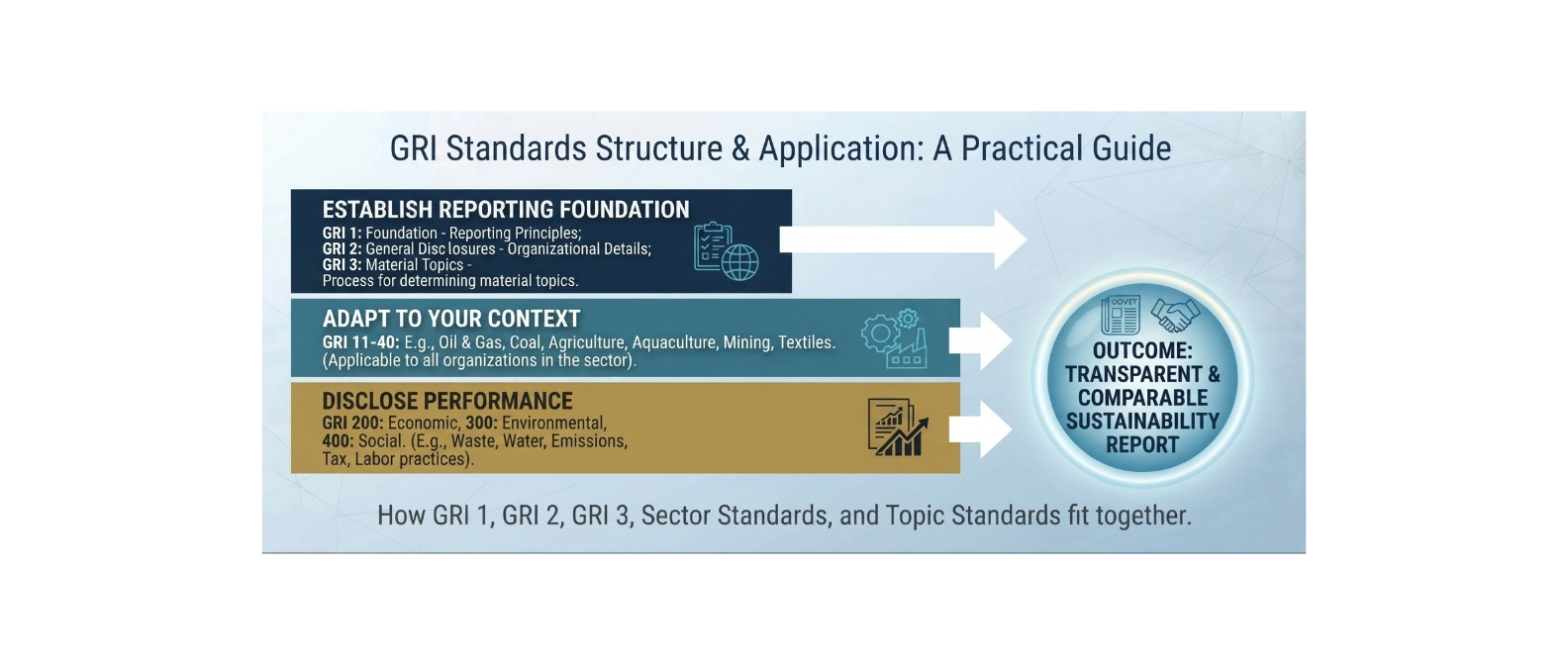
The Global Reporting Initiative Standards are the oldest and most widely used sustainability reporting framework in the world, built from three layers that work together rather than competing with each other.
Universal Standards apply to every organization, no matter the industry. GRI 1 (Foundation) sets out the basic rules and principles — accuracy, comparability, verifiability. GRI 2 (General Disclosures) asks for organizational context: how you’re structured, how you govern sustainability, how you engage stakeholders. GRI 3 (Material Topics) is where the real thinking happens — it walks you through identifying which sustainability issues actually matter for your business and the people affected by it, rather than reporting on everything indiscriminately.
Sector Standards narrow the focus for specific industries — currently oil and gas, coal, and agriculture/aquaculture/fishing, with more in development — flagging the topics that are almost always material for companies in that sector, so nothing important gets missed by oversight rather than by choice.
Topic Standards are the specific subjects themselves: emissions, water, waste, occupational health and safety, tax, labor practices, and dozens more. You don’t report on all of them. You report on the ones GRI 3’s materiality process actually surfaced as relevant to your business.
Put simply: Universal Standards tell you who you are and how you think about impact. Sector Standards tell you where to look. Topic Standards give you the specific disclosures once you know what to report on. A GRI-aligned report isn’t a template you fill in — it’s a process you go through, and the report is what that process produces.
Why GRI and IFRS S1/S2 Aren’t Actually Competing
Here’s where a lot of confusion in the market comes from, and it’s worth untangling honestly rather than glossing over.
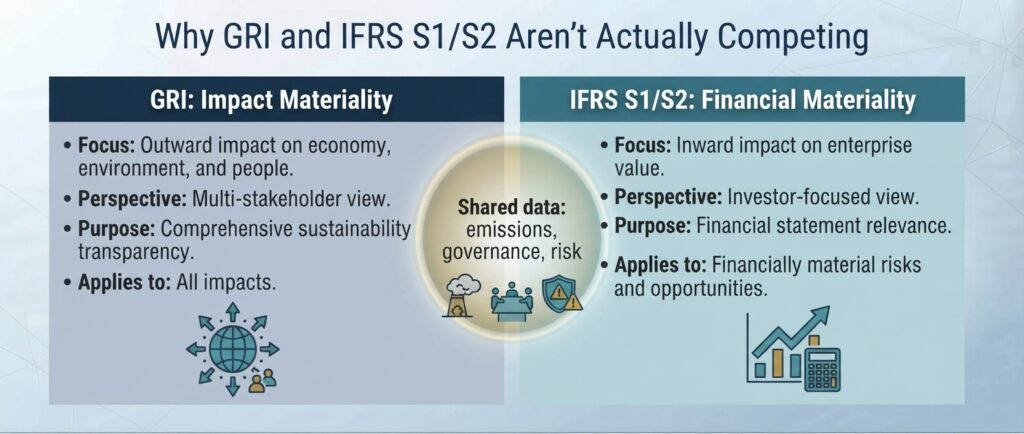
GRI asks: what impact is this business having on the economy, the environment, and people — regardless of whether that impact shows up in a financial statement. IFRS S1 and S2 ask a narrower question: what sustainability and climate information would a lender or investor need to make a decision about this specific company’s cash flows and value. One is about impact. The other is about financial risk. They’re different lenses on the same underlying reality, not two versions of the same thing.
That’s exactly why most well-built sustainability reports in this region use both rather than choosing one. GRI gives you the broad, credible impact story that satisfies employees, communities, NGOs, and regulators who care about more than shareholder value. IFRS S1/S2 gives you the narrower, financially-material subset that satisfies the audience your CFO actually has to answer to. A report built well on GRI’s materiality process makes the IFRS S1/S2 layer easier to add later — the data collection, the governance structure, and the stakeholder engagement you did for GRI don’t get thrown away; they become the foundation the financial-materiality layer sits on top of.
This is also why this piece pairs with our explainer on GHG accounting and Scope 1, 2, and 3 emissions — emissions data is exactly the kind of thing that shows up in both frameworks, just measured and framed slightly differently depending on which audience you’re speaking to.
Why GRI Still Carries Real Weight in the UAE and Qatar Specifically
This isn’t a theoretical exercise — GRI is written directly into the regional regulatory fabric, even where the language has shifted toward ISSB more recently.
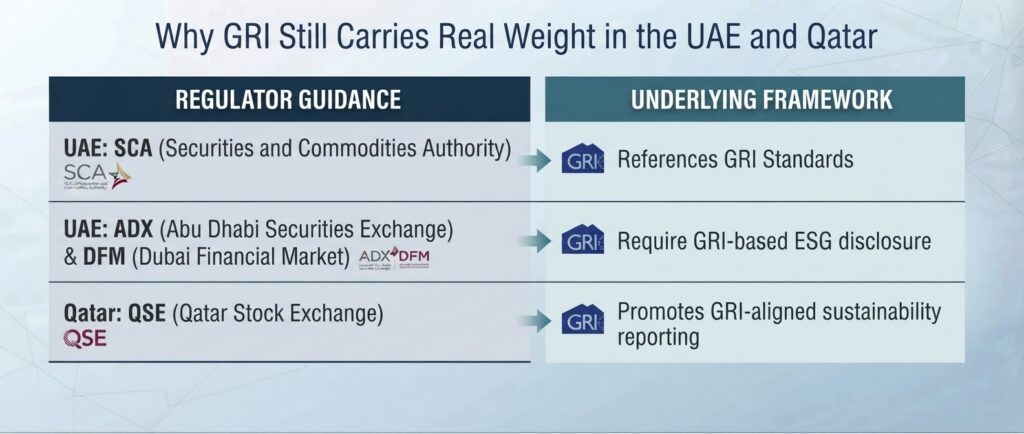
In the UAE, SCA’s Article 76 requirement explicitly directs listed companies to report in line with GRI standards, and both ADX’s and DFM’s ESG disclosure guidance were built on GRI, alongside TCFD and the Sustainable Stock Exchanges Initiative’s metrics. In Qatar, QSE’s 34-KPI ESG reporting guidance is likewise structured around GRI and TCFD, aligned with the GCC’s regional Unified ESG Metrics. Neither exchange has torn that foundation up in favor of IFRS S1/S2 — they’re layering the newer standard on top of it, not replacing it.
Practically, that means if your company is already reporting to satisfy SCA, ADX, DFM, or QSE guidance, you’re almost certainly already working within a GRI-shaped structure whether or not anyone has named it that way to you. Understanding GRI properly — not just filling in a template someone handed you — is what turns that existing obligation into something genuinely useful, rather than a document produced once a year and never looked at again.
What It Actually Takes to Build a Credible GRI Report
This is the part most explainers skip, and it’s the part that actually matters if you’re the person who has to produce the thing.
Start with materiality, not with disclosures. The single most common mistake we see is a team opening the GRI Topic Standards list and trying to report against all of them, or against whichever ones a template happened to include. That’s backwards. GRI 3’s materiality assessment — genuinely asking which of your impacts matter most, to whom, and why — is supposed to come first, and it should involve real conversations with employees, customers, and other stakeholders, not just a desk exercise done by one person in a week.
Build your governance and data story honestly, not aspirationally. GRI 2’s general disclosures ask direct questions about how sustainability is governed at board level, what policies actually exist versus what’s aspirational, and how stakeholder engagement actually happens. A report that overstates governance maturity is more damaging than one that honestly describes where you are and where you’re headed — sophisticated readers, including regulators and investors, can tell the difference, and the gap between claim and reality is exactly what erodes trust in a report over time.
Select topics deliberately, and be prepared to explain why others were excluded. Once materiality is done, the Topic Standards you report against should be a direct, traceable outcome of that process — not a list assembled to look thorough. A shorter report that clearly reflects genuine materiality work reads as more credible than a longer one that reads like a checklist.
Treat data collection as infrastructure, not a once-a-year scramble. The reports that hold up year after year are the ones where the underlying data — emissions figures, workforce metrics, safety incidents — comes from systems built to produce it repeatedly and auditably, not from a frantic collection exercise the month before publication. This is usually where the real cost of doing it alone shows up: not in writing the report, but in building and maintaining the data pipeline behind it.
Where This Usually Goes Wrong Without Outside Help
None of this is conceptually difficult. What’s difficult is doing it honestly, under time pressure, without a second pair of eyes checking whether the materiality assessment was genuine or performative, whether the disclosures actually match what GRI’s technical requirements ask for, and whether the final report will survive being read closely by someone who knows the standard — an investor’s ESG analyst, an exchange reviewer, or a journalist looking for the gap between claim and evidence.
That’s the value a genuine GRI reporting consultant adds — not writing prose around data you already have, but making sure the process behind the report is sound before a single page gets drafted, so what comes out the other end is something you’d be comfortable defending, not just publishing.
FAQ
Is GRI mandatory in the UAE or Qatar?
Indirectly, yes, for listed companies. SCA’s Article 76 explicitly requires GRI-aligned reporting for UAE public joint stock companies, and both ADX and DFM’s disclosure guidance are built on GRI. In Qatar, QSE’s ESG KPI framework is likewise structured around GRI alongside TCFD and regional metrics.
Do I need GRI if IFRS S1/S2 is becoming mandatory in my market?
Yes — they answer different questions. IFRS S1/S2 covers financially material sustainability risk for investors and lenders. GRI covers your broader impact on people and the environment. Most credible reports in this region use both, with GRI’s materiality and data work forming the foundation the IFRS layer builds on.
How long does a proper GRI reporting process take?
Longer than most companies expect if it’s done from scratch — a genuine materiality assessment, data infrastructure, and first report typically take a few months, not weeks. Subsequent years move faster once the underlying systems and stakeholder relationships are established.
What’s the biggest mistake companies make with GRI reporting?
Starting from the Topic Standards list instead of from a genuine materiality assessment. Reporting on the wrong topics — or on too many topics without clear reasoning — undermines credibility even when the individual disclosures are accurate.
Can a private, unlisted company benefit from GRI reporting?
Yes. GRI isn’t limited to listed companies, and increasingly private businesses use it to respond credibly to ESG questions from banks, investors, and larger clients, even without a regulatory requirement to do so.
Want to talk to a GRI Reporting Consultant?
If your business is already producing ESG disclosures for SCA, ADX, DFM, or QSE — or is being asked for sustainability data by a bank, investor, or client — the question worth answering honestly is whether the process behind that reporting would hold up to real scrutiny, or whether it’s been assembled to look complete rather than built to be genuinely defensible.
At The One Percent, and we’ll walk through exactly where your current reporting stands against GRI’s actual requirements — what’s solid, what’s assembled for appearances, and what a credible materiality process and report would take to build properly, in the UAE, Qatar, or across the GCC.
This article is for general information and does not constitute legal or accounting advice. GRI requirements referenced are current as of publication; always confirm current disclosure obligations directly with SCA, ADX, DFM, QFMA, QSE, or a qualified advisor.