
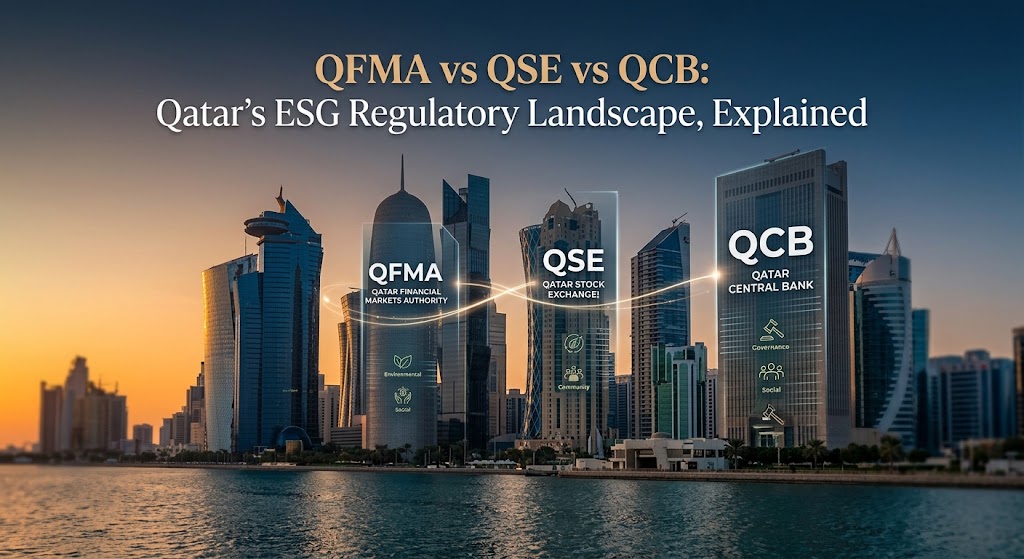
QFMA vs QSE vs QCB: Qatar’s ESG Regulatory Landscape, Explained
Three regulators changed the rules on Qatari businesses in the last eighteen months. Most companies have only noticed one of them.
Ask a finance lead in Doha which ESG rule actually applies to their company, and you’ll usually get the same confident answer: “we’re not listed, so it doesn’t.” That answer used to be safe. As of December 2025, it isn’t anymore – and the businesses about to find that out the hard way are rarely the ones who saw it coming.
Here’s why that gap exists: three institutions – QFMA, QSE, and QCB – have each moved on ESG in the past year, on different timelines, with almost nothing published that explains how the three actually connect. So before your bank, your biggest client, or your board asks the question first, here’s the map nobody handed you.
The three pillars, at a glance
| Regulator / Instrument | What it is | Who it applies to | Status |
|---|---|---|---|
| QFMA (Qatar Financial Markets Authority) | Governance Code for Listed Companies (Board Decision No. 5 of 2025) | Companies listed on QSE’s Main Market (mandatory) and Venture Market (comply-or-explain) | Mandatory |
| QSE (Qatar Stock Exchange) | ESG Reporting Guidance & Sustainability Dashboard | QSE-listed companies | Voluntary framework, operationalizing QFMA’s mandate |
| QCB (Qatar Central Bank) | Sustainability Reporting Framework (SRF), built on IFRS S1/S2 | All banks and insurance companies licensed by QCB | Mandatory, regardless of listing status |
Two of these sit close together – QFMA sets the legal requirement, QSE gives listed companies the template to meet it. The third stands apart entirely, reaching regulated financial institutions whether or not they’re anywhere near the exchange. That’s the distinction that catches people off guard.
QFMA: where the legal obligation actually lives
Start here, because everything downstream traces back to it – and because this is usually the point where a compliance lead realizes the ground has shifted under them without warning. In August 2025, the QFMA quietly retired its 2016 governance framework and issued the Governance Code for Listed Companies under Board Decision No. 5 of 2025 – published in the Official Gazette on 17 August 2025, effective the very next day. For the first time, Qatar ESG reporting requirements are a formal governance obligation, not a nice-to-have: listed companies must now publish periodic reports on sustainability, climate-related risk, and corporate social responsibility, sitting right alongside financial statements and governance disclosures.
The Code splits enforcement by market tier, and this is where it gets personal depending on where your company sits. Main Market companies must fully comply – no room to negotiate. Venture Market companies get a comply-or-explain path, which sounds gentler until you realize “explain” means publicly justifying, in writing, exactly why you didn’t. Either way, everyone in scope was handed 12 months from Gazette publication to comply – a window the QFMA Chair can extend, but one that’s already quietly counting down for anyone who hasn’t started.
QSE: the exchange’s answer to “how do we actually report this?”
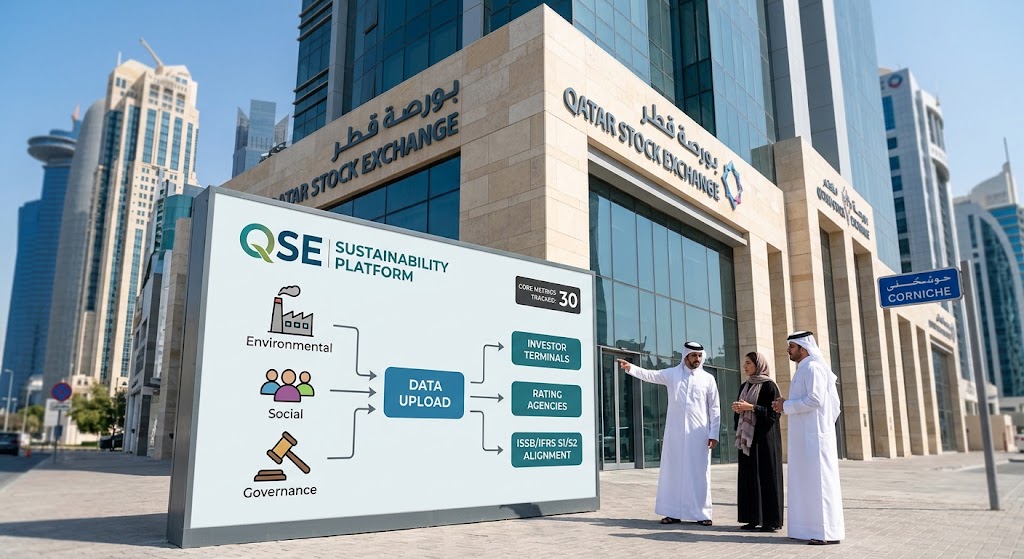
QFMA tells listed companies that they must disclose. QSE has spent nearly a decade quietly building the infrastructure for how – which, if you’re the one who has to actually produce the report, is the part that matters more than the legal text. The exchange joined the UN Sustainable Stock Exchanges initiative back in 2016 and has since published detailed ESG reporting guidance covering 34 QSE-specific KPIs, aligned with the GCC Unified ESG Metrics – a standardized 29-indicator set shared across Gulf exchanges, including ADX and DFM, so a sustainability report built to QSE’s structure travels well across the region instead of needing to be rebuilt from scratch for every market you touch.
Technically, this Qatar Stock Exchange ESG guidance is still framed as voluntary. In practice, it’s the only structured template that actually satisfies what QFMA’s Governance Code now legally demands – so for any QSE-listed company, “voluntary” describes the exchange’s choice of words, not your real exposure. QSE also runs a Sustainability and ESG Dashboard, letting listed companies benchmark their metrics against peers in plain view – which has quietly become a signal institutional investors are watching closely when deciding where their money goes.
QCB: the mandate that has nothing to do with being listed
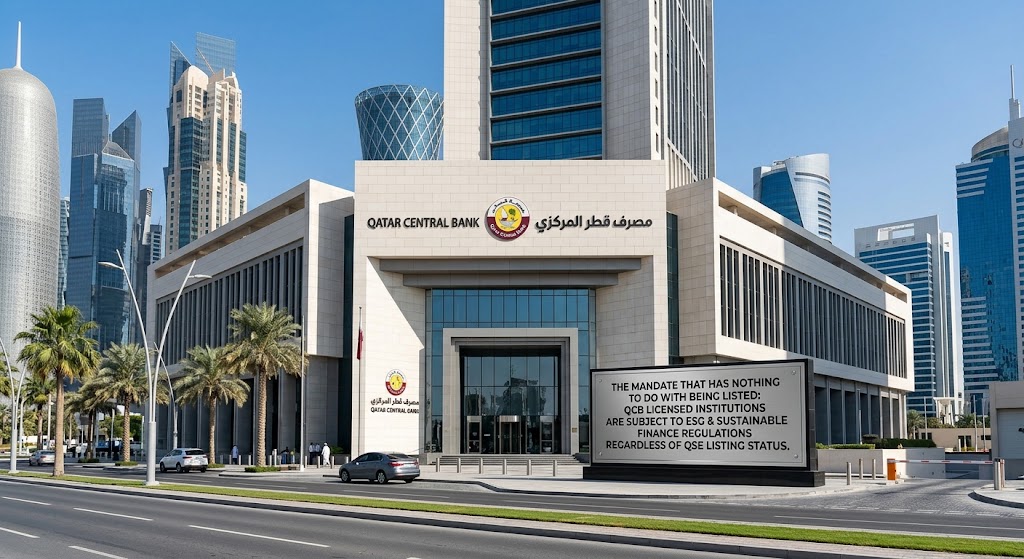
This is where the “we’re not listed, so we’re fine” logic quietly falls apart – and where it’s worth pausing, because this is the one most businesses genuinely don’t see coming. On 4 December 2025, the Qatar Central Bank issued its Sustainability Reporting Framework (SRF) for financial institutions, built directly on IFRS S1 and IFRS S2 – the ISSB’s global sustainability and climate disclosure standards, the same ones now anchoring ESG regulation across the Gulf. It applies to every bank and insurance company licensed by QCB, whether or not that institution has ever filed a single document with the Qatar Stock Exchange.
Implementation began on 1 January 2026. The first sustainability report will cover FY2026 data, due in 2027, following a phased rollout with transitional relief for institutions still standing up their data infrastructure. This isn’t a one-off pilot to note and forget – it’s a permanent, annually recurring regulatory obligation, sitting on top of QCB’s broader 2024 ESG and Sustainability Strategy for the financial sector, which already commits the central bank to climate risk stress testing, green prudential regulation, and sustainable finance disclosure across every institution it supervises.
If your business is a QCB-licensed bank or insurer, this reaches you directly, full stop. Your listing status was never the question.
The part that reaches companies who aren’t regulated by any of the three
Here’s what doesn’t show up cleanly in any single regulator’s mandate, but ends up mattering just as much – maybe more, if you’re the one fielding the email: QCB-regulated banks and QSE-listed companies are the ones lending to, investing in, and buying from everyone else in the Qatari economy. As those institutions move toward IFRS S1/S2-aligned reporting, the data they need to complete their own disclosures doesn’t stay inside their own four walls. It flows downstream – into supplier questionnaires, lending covenants, and tender requirements that land on desks that have never once thought about ESG compliance in Qatar.
A 2024 Invest Qatar report found that only 31% of local financial institutions currently run climate-related stress testing, and just 18% require ESG disclosure from their borrowers – numbers that are only moving in one direction now that QCB’s SRF is live. Meanwhile, some of the country’s largest banks are already well ahead of the mandate: one of Qatar’s top lenders reported that ESG-linked lending made up over 12% of its corporate loan book in 2024, more than double what it was two years earlier. That’s not a regulatory footnote. That’s a bank actively steering capital toward companies that can produce credible ESG data – and quietly away from the ones that can’t.
None of that requires your company to be listed, licensed by QCB, or named in any decree. It just requires being a supplier, borrower, or partner to someone who is – and in an economy this interconnected, that’s most businesses in the country, whether they’ve noticed yet or not.
So which one applies to you?
A rough map – not legal advice, just a starting point:
- Listed on QSE’s Main Market? You’re fully bound by QFMA’s Governance Code, and your ESG disclosure should follow QSE’s guidance and its 34-KPI structure – not a generic template.
- Listed on QSE’s Venture Market? You’re on a comply-or-explain basis – which still means publishing a position, not staying silent.
- A bank or insurer licensed by QCB, listed or not? You’re inside the Sustainability Reporting Framework, with your first IFRS S1/S2-aligned report due on FY2026 data.
- None of the above, but your bank, a major client, or an investor has started asking for ESG data anyway? You’re in the fastest-growing category in the country right now – not because a law reaches you yet, but because the institutions that fund and buy from you are already being asked, and they’re passing the question along.
Why this is worth getting ahead of, not catching up to
Three regulators. Two of them newly mandatory within the last year. All converging on the same global standard – IFRS S1/S2 – from three completely different directions. If you haven’t mapped all three against your own business yet, you’re not behind – you’re simply on the same timeline as almost everyone else. QFMA’s Code is barely a year old. QCB’s Framework only began implementation in January 2026. Nobody’s had this figured out for long.
That’s exactly the gap D1Percent works in, day to day, as a hands-on Qatar ESG regulatory compliance consultant for businesses in exactly this position. We’ve been building GRI-aligned ESG and Sustainability Reports for growing Qatari businesses – structured to hold up to real scrutiny today, and to extend cleanly into IFRS S1/S2 disclosure the moment a company lists, grows, or starts fielding ESG questions from a lender or a larger client. The goal was never to comply with everything at once. It’s knowing, with confidence, exactly what’s required of your business right now versus what’s simply coming – and having something credible sitting ready before someone else asks for it on short notice.
Not sure where your business actually sits across QFMA, QSE, and QCB – or what a lender or investor might ask for next quarter? Book a Free Compliance Assessment with D1Percent, and we’ll map your exact position before that question lands on your desk.
This article is for general information and does not constitute legal advice. Regulatory requirements referenced are current as of publication; always confirm scope and deadlines directly with QFMA, QSE, QCB, or a qualified advisor.