
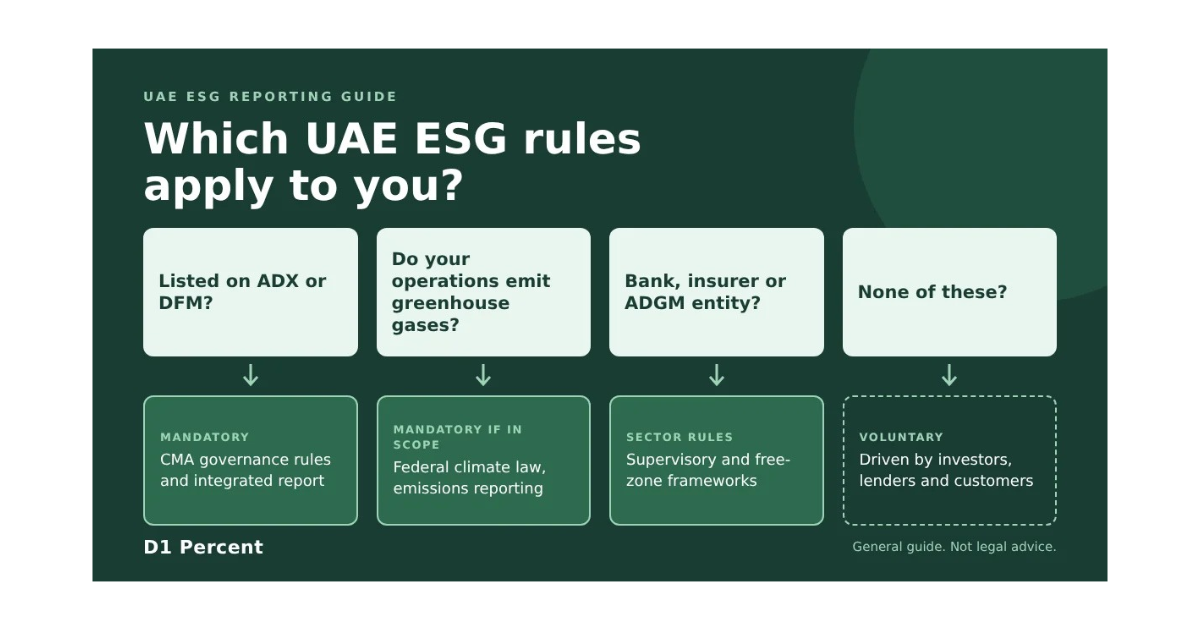
Is ESG reporting mandatory in the UAE? For some companies, yes. For most, not in the form of a full public ESG report. The answer depends on your listing status, sector, regulator and jurisdiction, and on which obligation you mean: sustainability disclosure, greenhouse gas (GHG) emissions reporting, or sector-specific climate-risk duties.
Listed on ADX or DFM? Follow the Capital Market Authority’s governance rules.
Operations emit greenhouse gases? Federal Decree-Law No. 11 of 2024 may apply to you.
Bank, insurer or ADGM entity? Sector and free-zone frameworks apply.
None of these? Your pressure comes from investors, lenders and customers, not from a legal duty.
This guide separates what is required from what is expected and what is optional. It also marks the points that still need confirming against official texts, because the UAE ESG reporting regulations changed in 2025 and 2026.
Is ESG Reporting Mandatory for All Companies in the UAE?
No. We found no UAE rule that requires every company to publish a full ESG report. Mandatory ESG reporting in the UAE is a set of separate duties, and four different things are often mixed together:
- Mandatory sustainability disclosureA legal duty to disclose sustainability information, which applies to UAE-listed public joint stock companies.
- Mandatory GHG emissions reportingA legal duty to measure, record and report emissions, for in-scope emitters under the federal climate law. It is not the same as a full ESG report.
- Sector-specific obligationsSupervisory expectations for financial institutions, and comply-or-explain disclosure for certain ADGM entities.
- Voluntary and investor-driven disclosureReporting that lenders, investors, customers and supply chains ask for, with no legal duty behind it.
| Who may be affected | Regulatory source | Type of obligation | Key caveat |
|---|---|---|---|
| UAE-listed public joint stock companies (ADX, DFM) | CMA (formerly SCA) Governance Guide, Decision No. 3/Chairman of 2020, as amended | Integrated report that includes sustainability reporting | Confirm the exact wording of Article 76 and the CMA clarification. ADX and DFM ESG guides are guidance |
| Entities with GHG-emitting operations in the UAE, including free zones | Federal Decree-Law No. 11 of 2024 | Measure, record and report emissions, and contribute to reductions | The law sets no size threshold. MOCCAE or the emirate authority decides which sources report. Implementing guidance is still emerging |
| Very large emitters (Scope 1 and 2 of 0.5 million tCO2e or more) | Cabinet Resolution No. 67 of 2024 | Registry registration, annual Scope 1 and 2 reports, third-party verification | Applies only at or above the threshold |
| CBUAE-licensed banks and insurers | CBUAE climate-risk requirements and UAE Sustainable Finance Working Group principles | Supervisory climate-risk management and disclosure expectations | Confirm the instrument, status and scope for insurers. Not a duty to publish an ESG report |
| ADGM entities above US$68 million turnover, and FSRA-licensed fund managers above US$6 billion AUM | ADGM Companies Regulations (Amendment No. 2) 2023 | Comply or explain ESG disclosure | Several entity types are out of scope or exempt |
| DIFC entities | Federal climate law applies. DFSA follows SFWG principles | No general ESG disclosure mandate found | Confirm against the DFSA Rulebook |
| Unlisted mainland companies | No general ESG publication rule | Voluntary, plus the climate law if designated | Lender, investor and customer requests still apply |
Two companies in the same row can face different requirements. Use the table to find your starting point, not your final answer.
ESG Reporting Requirements for UAE-Listed Companies
Start with the regulator’s name. The Securities and Commodities Authority (SCA) became the Capital Market Authority (CMA) on 1 January 2026 under Federal Decree-Law No. 32 of 2025. The CMA is the SCA’s legal successor, and resolutions issued before that date stay in force until replaced, unless they conflict with the new laws. Many documents, including older guidance, still say SCA.
The core obligation sits in the Governance Guide. The Governance Guide for public joint stock companies (Chairman of the SCA Board Decision No. 3 of 2020, later amended) requires listed companies to disclose a periodic integrated report. Advisers who summarise the Guide describe Article 76 as requiring sustainability reporting within that report, and the SCA issued a clarification on content after the Guide took effect. The disclosure is tied to the financial year-end and the annual general meeting, so check the current Guide for the deadline that applies to your year-end.
ADX and DFM add structure, not necessarily obligation. Each exchange publishes ESG reporting guidance with suggested metrics, and both point to international frameworks. Treat exchange guidance as guidance unless the CMA or the exchange states a requirement in its own rules. Some commentators call parts of it mandatory, so read the exact wording for your exchange. If you are listed on both, check both. For a deeper look at the Abu Dhabi side, read our guide to ADX sustainability reporting.
UAE Climate Change Law and Mandatory Emissions Reporting
Federal Decree-Law No. 11 of 2024 on the Reduction of Climate Change Effects came into force on 30 May 2025. It is the clearest UAE climate change reporting requirement for the wider economy, and it applies whether or not you are listed.
Who may be in scope
The law applies to emission “sources”: public and private entities whose operations release greenhouse gases, including those in free zones. The law itself sets no size threshold. The Ministry of Climate Change and Environment (MOCCAE) or the competent emirate authority determines which sources must report. Abu Dhabi has a live programme for facilities emitting 25,000 tCO2e or more of Scope 1 emissions in covered sectors, with annual reports due by 31 March. Abu Dhabi expects independent verification from the 2026 reporting year.
What carbon emissions reporting in the UAE involves
In-scope entities must measure emissions, keep an inventory and records (advisers report five years), report to the competent authority, and take reduction measures. Violations carry fines of AED 50,000 to AED 2,000,000, with higher penalties for repeats. Separately, Cabinet Resolution No. 67 of 2024 applies to entities with combined Scope 1 and 2 emissions of 0.5 million tCO2e or more, and adds registry registration, annual Scope 1 and 2 reports under the GHG Protocol and third-party verification.
Where implementation stands
Emissions reporting is not an ESG report
An emissions-reporting duty does not oblige you to publish a full ESG report. It does mean you need an inventory you can document and defend, which also feeds any sustainability report you publish. Our carbon accounting and GHG reporting support covers that groundwork.
ESG Reporting for Banks and Insurers in the UAE
Banks and insurers face supervisory expectations that go beyond the listed-company and climate-law duties above. The Central Bank of the UAE (CBUAE) regulates them, and advisers report that it issued a climate-related financial risk management regulation (Circular C 8/2025) that took effect in July 2025. The UAE Sustainable Finance Working Group (SFWG), whose members include the CBUAE, the SCA, the DFSA and the ADGM FSRA, has also issued principles on climate-related financial risk (November 2023) and on sustainability-related disclosures (June 2024). The SFWG describes the disclosure principles as minimum expectations for licensed institutions.
Which regulator applies depends on where you are licensed. CBUAE-regulated firms differ from firms regulated by the DFSA in DIFC or the FSRA in ADGM. Confirm the instrument and its status for your licence, including whether it applies to insurers. These are supervisory and risk-management duties, not a general requirement to publish an ESG report. Our detailed article covers ESG reporting requirements for banks and insurers in the UAE.
ESG Reporting in ADGM and DIFC
ADGM has a specific framework. The ESG Disclosures Framework was enacted on 21 June 2023 through the ADGM Companies Regulations (Amendment No. 2) 2023. It applies to ADGM entities with turnover above US$68 million in a financial year, and to FSRA-licensed fund and asset management companies with assets under management above US$6 billion. In-scope entities comply or explain, and disclose against a globally recognised standard such as CDP, GRI, ISSB or TCFD, filed with annual accounts. Several entity types, including foundations, LLPs, partnerships and branches of foreign companies, are out of scope or exempt, and may comply voluntarily. Read the ADGM ESG Disclosures Framework for the current thresholds.
DIFC works differently. In the sources we reviewed, the DFSA describes its sustainable finance work as strategy and guidance, and we found no general ESG disclosure mandate for DIFC entities. The federal climate law still applies to emission sources in free zones, and DIFC financial firms sit within the SFWG principles. Do not assume ADGM and DIFC rules are interchangeable, or that the same rules apply to every entity registered in either.
Which ESG Reporting Framework Should UAE Companies Use?
A framework tells you how to report. It does not decide whether you must. Their status in the UAE differs:
| Framework | What it covers | UAE status |
|---|---|---|
| GRI Standards | A company’s impacts on the economy, environment and people | Voluntary international standard. Referenced in guidance for listed companies and accepted by ADGM. Confirm whether the CMA’s rules require GRI alignment for your report |
| IFRS S1 and S2 (ISSB) | Sustainability and climate information that investors need | Not formally mandated across the UAE in the sources we reviewed. Referenced in exchange guidance and accepted by ADGM. Check for any instrument from your regulator or exchange |
| TCFD recommendations | Climate-related governance, strategy, risk and metrics | A set of recommendations, not a UAE legal requirement. IFRS S2 builds on it, and ADGM lists it as an acceptable standard |
| CDP, SASB and sector or investor frameworks | Specific disclosure or industry metrics | Voluntary. Often requested by investors and customers |
Choosing a framework does not by itself make you compliant. Compliance means meeting the obligation that applies to your entity, then using a framework to structure the disclosure.
What Happens If a Company Is Not Currently Required to Publish an ESG Report?
Even when no rule requires a public report, ESG capability often becomes necessary for commercial reasons. These are business drivers, not universal legal duties:
- Investors and lenders ask for consistent, traceable ESG data in reviews and credit decisions.
- Procurement and customers send supplier ESG assessments and ask for emissions data.
- Emissions management becomes unavoidable if the climate law designates your operations.
- Readiness. A written ESG policy and a first baseline cost less to build before a deadline than during one. See also why businesses need ESG reporting.
How UAE Businesses Can Prepare for ESG Reporting
ESG compliance in the UAE starts with knowing your obligations, and the steps vary with your reporting maturity. ESG reporting for UAE companies usually follows this sequence:
- Determine your legal entity, regulator, listing status and jurisdiction.
- Identify the disclosure and emissions-reporting obligations that apply.
- Select the reporting framework or methodology.
- Establish data ownership and governance. Name an owner for each metric.
- Collect environmental, social and governance data.
- Set up emissions measurement and document calculation methods.
- Validate data and keep evidence and records.
- Review material risks and disclosures with internal stakeholders.
- Obtain management, board or external review where required or useful.
- Monitor regulatory developments and keep an annual reporting calendar.
If you are building this for the first time, our ESG reporting services team can map the steps to your obligations.
Frequently Asked Questions
Is ESG reporting mandatory for all companies in the UAE?
No. We found no rule requiring every company to publish a full ESG report. Obligations depend on listing status, sector, regulator, jurisdiction and activities.
Is ESG reporting mandatory for UAE-listed companies?
Listed public joint stock companies must disclose an integrated report under the CMA’s (formerly the SCA’s) Governance Guide, and advisers read Article 76 as including sustainability reporting. ADX and DFM guidance helps structure it. Confirm the exact requirement and deadline in the current Guide.
Do private companies in the UAE need to publish ESG reports?
There is no general duty to publish an ESG report. However, the federal climate law applies to emitting entities regardless of listing status, and lenders, investors and large customers often ask private companies for ESG data.
Is carbon emissions reporting mandatory in the UAE?
For entities in scope of Federal Decree-Law No. 11 of 2024, yes. The law applies to emission sources, including those in free zones. MOCCAE or the emirate authority determines which sources must report and how, and implementing guidance is still emerging. Abu Dhabi runs a live programme for facilities at or above 25,000 tCO2e of Scope 1 emissions in covered sectors.
Are IFRS S1 and IFRS S2 mandatory in the UAE?
Not as a general rule, based on the sources we reviewed. Some UAE guidance references ISSB standards, and ADGM accepts ISSB as a disclosure standard. Check whether your regulator or exchange has issued a specific requirement.
Is GRI reporting mandatory in the UAE?
GRI is a voluntary international standard. UAE guidance for listed companies references it, and ADGM lists it as an acceptable standard. Check whether the CMA’s rules or clarification require GRI alignment for your report.
What are the ESG reporting requirements for UAE banks?
CBUAE-regulated banks face climate-related financial risk management requirements, reported as Circular C 8/2025, effective July 2025, plus the SFWG principles. Listed banks also follow the listed-company rules. Confirm each instrument’s status for your licence. See our guide to ESG reporting requirements for banks and insurers in the UAE.
Do companies in UAE free zones have ESG or emissions-reporting obligations?
For emissions, yes: the federal climate law applies to sources in free zones. For ESG disclosure it depends on the free zone. ADGM has a comply-or-explain framework above set thresholds, and we found no general ESG disclosure mandate for DIFC entities.
How can a UAE company determine which ESG requirements apply to it?
Ask five questions. Are you listed? Who regulates your licence? Which jurisdiction are you registered in? Do your operations emit greenhouse gases? Do your lenders, investors or customers require ESG data? Your answers point to the rules that apply, and a regulatory specialist can confirm them.
Understand Your ESG Reporting Obligations Before Your Next Reporting Cycle
So, is ESG reporting mandatory in the UAE? Not for every company, and not always as a full ESG report. Listed companies have a sustainability disclosure duty through the CMA’s governance rules. In-scope emitters have a legal duty to measure and report emissions. Financial institutions and certain ADGM entities face sector-specific expectations. For everyone else, ESG reporting is voluntary and driven by the market.
The practical risk is not knowing which group you are in. Work that out before your next reporting cycle, because the rules are still moving.
D1 Percent can help organisations assess their reporting readiness, organise ESG data, and plan their sustainability reporting approach.
Contact D1 Percent