
Most UAE banks and insurers are asking the wrong first question. “Do we have to publish an ESG report?” has no single answer, because the obligation depends on who licenses you, whether you are listed, and which law you test against. The better question is which requirements bind your institution today.
The short answer is yes for some obligations and no for others. Banks and insurers licensed by the Central Bank of the UAE (CBUAE) must meet a binding climate-related financial risk regulation. Listed public joint stock companies must publish an annual sustainability report. IFRS S1, IFRS S2 and GRI are not universal mandates for the sector. This guide sets out the ESG reporting requirements for banks and insurers in UAE in three groups: binding, guided and voluntary.
Is ESG Reporting Mandatory for Banks and Insurers in the UAE?
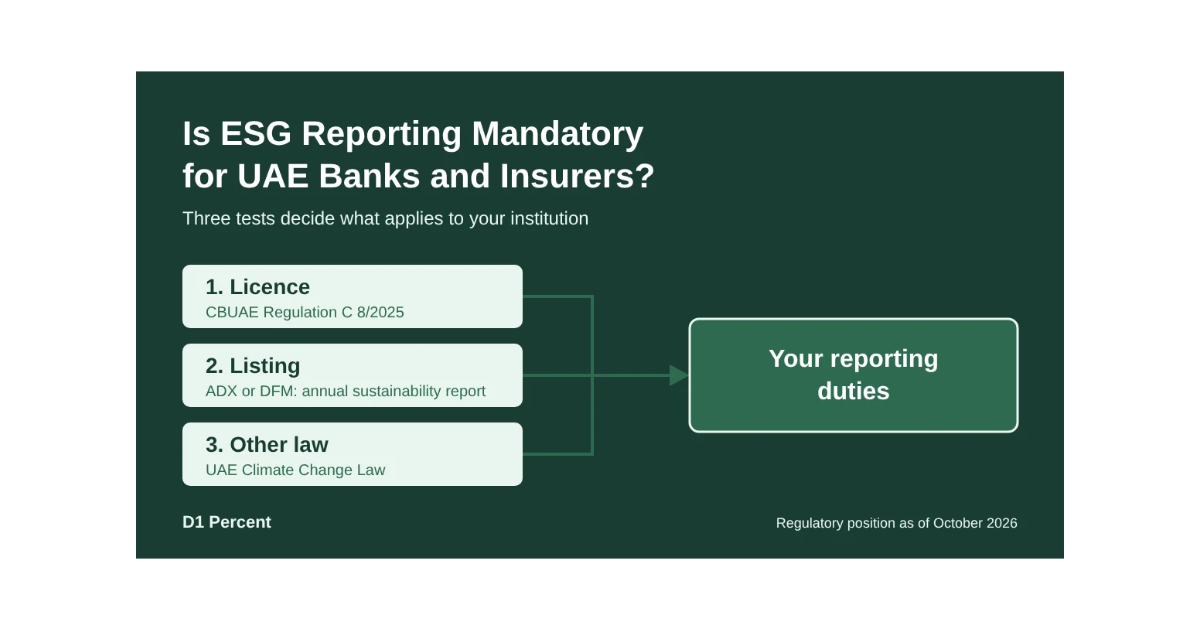
It depends on three tests. A CBUAE licence makes the Climate-related Financial Risk Management Regulation (C 8/2025) binding on your governance, risk management and internal reporting. A listing on the Abu Dhabi Securities Exchange (ADX) or Dubai Financial Market (DFM) makes an annual sustainability report mandatory under Article 76 of the Securities and Commodities Authority (SCA) Governance Guide. Separately, the UAE Climate Change Law sets emissions-reporting duties. I found no UAE-wide rule making IFRS S1, IFRS S2 or GRI compulsory for every bank and insurer. Check each test against your own licence and listing status.
Which UAE Authorities Shape ESG Reporting Requirements?
Five bodies shape ESG disclosure requirements in the UAE. Supervision tells you what you must do. Exchange guidance tells you how to present it.
| Authority | What it issued | Binding on banks and insurers? |
|---|---|---|
| Central Bank of the UAE (CBUAE) | Climate-related Financial Risk Management Regulation (C 8/2025, issued 14 October 2025); Principles for Sustainability-Related Disclosures (14 June 2024) | Regulation: yes. Disclosure Principles: expectations, with each authority deciding how to apply them |
| UAE Sustainable Finance Working Group (SFWG) | Principles on climate risk (November 2023), sustainability disclosures (June 2024) and climate transition planning (late 2025) | No. A shared statement of expectations by ministries, regulators and exchanges |
| Capital Market Authority (CMA), formerly the SCA | Governance Guide for public joint stock companies, including Article 76 | Yes, if the institution is a listed public joint stock company |
| ADX and DFM | ESG disclosure guidance (ADX); Guide to ESG Reporting, 2025 edition (DFM) | Guidance on how to report, not the source of the duty |
| Ministry of Climate Change and Environment (MOCCAE) | Federal Decree-Law No. 11 of 2024 (Climate Change Law) | Yes, for entities treated as reporting sources |
The SCA became the CMA on 1 January 2026 under Federal Decree-Laws 32 and 33 of 2025, and the CMA succeeds to the SCA’s rights and obligations. Banks and insurers licensed in the Dubai International Financial Centre or Abu Dhabi Global Market answer to the Dubai Financial Services Authority or the Financial Services Regulatory Authority, not the CBUAE. Confirm your regulator first.
ESG Reporting Requirements for Banks in the UAE
This section covers the ESG reporting requirements for banks and insurers in UAE that sit in prudential regulation. Regulation C 8/2025 applies to banks and insurers on a solo and group-wide basis. The CBUAE may apply proportionality to smaller institutions and smaller branches of foreign banks. For banks, the binding obligations are:
- Governance. The board is accountable for oversight of climate-related financial risks, embeds them in risk appetite and reviews the climate component of risk appetite at least annually (Article 2). Board and senior management must keep their knowledge current, including through training.
- Strategy. Assess the effect of climate-related financial risks on the business model over the short, medium and long term (Article 3).
- Risk management. Build climate risk into the risk framework through a structured process covering identification, data gathering, measurement, reporting, control and mitigation. Credit, market, operational and liquidity risk each carry specific requirements (Article 4).
- Data and controls. Implement data management frameworks that support identification, measurement and reporting, and internal reporting that gives the board timely and accurate information (Articles 4.3 and 4.5).
- Scenario analysis. Run it at least annually, incorporate it into the Internal Capital Adequacy Assessment Process (ICAAP), and document the rationale, assumptions and results (Article 4.11).
- Capital. Banks completing an ICAAP must incorporate climate-related financial risks into it (Article 5.3).
- Green product governance. Products labelled green or ESG-linked need clear qualifying criteria, approval and customer due diligence (Articles 2.8 and 2.9).
Enforcement is real. Article 6 allows supervisory action and financial sanctions, and a bank that cannot show full compliance must submit a plan to the CBUAE explaining the gaps and the steps to close them (Article 8.2). The CBUAE’s Financial Stability Report 2025 also states that it plans a top-down climate stress test in 2026.
What the regulation does not do: the text I reviewed contains no requirement to publish a stand-alone ESG report. Public disclosure expectations sit in the CBUAE’s Principles for Sustainability-Related Disclosures. They use “should”, set minimum expectations on governance, strategy, risk management, metrics and targets, and leave each authority to decide whether to apply them as voluntary, comply-or-explain or mandatory rules. They also encourage independent assurance. A bank listed on ADX or DFM carries the additional Article 76 duty described below.
ESG Reporting Requirements for Insurance Companies in the UAE
The same regulation applies to insurers. The CBUAE defines an insurance company to include primary insurers, reinsurers and takaful operators. Do not copy a bank’s compliance plan across. The mechanics differ:
- Lines of business, not portfolios. Identification and concentration analysis run at line-of-business level (Articles 4.2 and 4.7.6).
- Underwriting. Climate-related financial risk must enter underwriting policies and assessments, including pricing risk from changing risk profiles of insured assets and from changing mortality and demographic trends (Articles 4.7.1 and 4.7.5).
- Liquidity. The regulation names higher liability claims and counterparty defaults as liquidity channels for insurers (Article 4.10.2).
- ORSA. Insurers conducting an Own Risk and Solvency Assessment (ORSA) must incorporate climate-related financial risks, where banks reference the ICAAP (Article 5.3).
- Liability risk. Climate-related compensatory claims and legal actions count as a risk driver for all institutions (Article 1.12).
My interpretation, not regulator text: an insurer’s data needs lean toward exposure by line of business, geography and peril, plus reinsurance counterparty information. Like banks, insurers face no stand-alone report mandate in the regulation. A listed insurer is subject to Article 76 as a listed public joint stock company.
How Do IFRS S1, IFRS S2 and GRI Fit Into UAE ESG Reporting?
IFRS S1 asks entities to disclose sustainability-related risks and opportunities that could reasonably affect their prospects, for investors and other providers of capital. IFRS S2 covers climate-related disclosures. The International Sustainability Standards Board (ISSB) issued both on 26 June 2023. Each jurisdiction decides whether and when to require them.
In the UAE, I found no instrument that makes them compulsory across the sector. KPMG UAE’s 2025 review notes that leading listed UAE entities are adopting them and that adoption could become mandatory. The SFWG disclosure principles recognise the ISSB standards as a route to a global baseline, and the ADX and DFM guides reference IFRS S1 and S2. Plan for adoption. Do not claim it is required.
GRI means the Global Reporting Initiative Standards, which focus on an organisation’s impacts on the economy, environment and people. For listed public joint stock companies, law-firm summaries of the SCA Governance Guide say reports must follow GRI plus exchange standards. For unlisted banks and insurers, GRI is voluntary.
The frameworks overlap more than they conflict. The CBUAE Disclosure Principles organise minimum disclosures around governance, strategy, risk management, metrics and targets, the same four pillars as IFRS S2. One data model can serve the regulation’s internal reporting, an IFRS S2 disclosure and a GRI report. They differ in materiality lens (investor-focused versus impact-focused) and reporting boundary. Aligning with a voluntary framework does not establish legal compliance.
What Information Should Banks and Insurers Prepare?
| Information area | What to assess | Why it matters |
|---|---|---|
| Governance | Board oversight, delegation records, training logs, named accountable owners | Clear responsibility and supervisory evidence |
| Materiality | Sustainability risks and opportunities that could affect finances or stakeholders | Focused disclosures |
| Climate risk | Physical, transition and liability risks by sector, geography and, for insurers, line of business | Risk assessment, scenario analysis and capital planning |
| Emissions | Scope 1 and 2 operational emissions, then financed or insurance-associated Scope 3 where material | Measurement, disclosure and any Climate Change Law duty |
| Data controls | Sources, owners, calculation methods, review and sign-off | Reliability and traceability |
| Reporting | Which disclosures apply to your licence and listing, and the reporting calendar | Timely preparation |
Actual data requirements depend on the institution and the rules applicable to it. Treat this table as a starting inventory, not a compliance list.
How Can Financial Institutions Prepare for ESG Reporting?
- Confirm applicable requirements. Record your licensing authority, listing status and Climate Change Law position in one page signed off by Legal and Compliance.
- Map frameworks and overlaps. Set the CBUAE regulation, Article 76 (if listed), IFRS S2 and GRI side by side and mark where one data point serves several.
- Review the materiality and risk assessment. Update it against the regulation’s short, medium and long-term horizons.
- Identify required data and assign owners. Every metric gets a named owner and a source system.
- Establish controls. Define collection, calculation and validation steps, with a second reviewer.
- Document methods and evidence. Write down assumptions, emission factors and scenario choices. The regulation expects scenario rationale and results to be documented.
- Build a reporting calendar. Add review and board approval milestones, working back from filing dates.
- Review gaps and consider assurance. Decide where independent assurance is appropriate or required. The CBUAE Disclosure Principles encourage it.
No checklist guarantees compliance. It does show a supervisor that the process is deliberate.
Common ESG Reporting Challenges for Banks and Insurers
These problems are common. They are operational, not evidence of failure.
- Fragmented data. Risk, finance, operations and procurement each hold a piece. KPMG UAE found many entities still collect ESG data manually in spreadsheets shared by email, which weakens the audit trail.
- Financed and supplier emissions. Counterparty data is thin, and methods vary. Estimates need clear labelling.
- Unclear ownership. A metric that belongs to everyone belongs to no one.
- Definition clashes. GRI, IFRS S2 and regulatory definitions of the same metric can differ.
- Short review windows. Validation and management review get squeezed into the final weeks.
- Uncertainty about scope. Teams hold off because they cannot tell which rule applies. Step 1 above fixes that.
Frequently Asked Questions
Is ESG reporting mandatory for all banks in the UAE?
No single rule covers every bank. CBUAE-licensed banks must meet Regulation C 8/2025 on climate-related financial risk. Banks listed on ADX or DFM must also publish an annual sustainability report. For unlisted banks I found no general duty to publish an ESG report. The Climate Change Law adds separate emissions-reporting duties.
Are insurance companies required to publish ESG reports in the UAE?
The CBUAE regulation binds insurers on governance, risk management, scenario analysis and ORSA integration, but it does not require a stand-alone published report. A listed insurer must publish a sustainability report under Article 76. An unlisted insurer should confirm any entity-specific expectations with its CBUAE supervisor.
Does CBUAE require banks to disclose climate-related risks?
It requires banks to identify, measure, manage and report climate-related financial risks internally to the board. Public disclosure is addressed in the June 2024 Disclosure Principles, which are expectations, and each authority decides how to apply them. Verify with the CBUAE whether any disclosure format applies to your institution.
Do ADX- and DFM-listed financial institutions have ESG disclosure obligations?
Yes. Article 76 of the SCA Governance Guide requires listed public joint stock companies to publish an annual sustainability report, submitted within 90 days of year-end or before the annual general assembly, whichever is earlier. ADX and DFM guides help structure the content. Verify the current text with the CMA.
Are IFRS S1 and IFRS S2 mandatory in the UAE?
I found no UAE-wide mandate for banks or insurers. The standards are voluntary unless a regulator requires them, and market guidance increasingly references them. Confirm the position with the CBUAE and CMA before relying on either answer.
Is GRI reporting compulsory for UAE financial institutions?
Not as a general rule. For listed public joint stock companies, summaries of the SCA Governance Guide tie sustainability reports to GRI Standards plus exchange standards. For unlisted institutions, GRI is a voluntary framework.
What ESG information should a UAE bank or insurer collect first?
Start with governance evidence and exposure data: board oversight records, climate-risk exposure by sector and geography (by line of business for insurers), and Scope 1 and 2 emissions. Add financed or insurance-associated emissions once ownership and controls exist.
How often should ESG information be reviewed and reported?
The CBUAE regulation requires the climate component of risk appetite and scenario analysis to be reviewed at least annually, and board reporting to be timely. Listed companies publish an annual sustainability report. Build a quarterly internal data review so the annual cycle has no surprises.
Building a More Reliable ESG Reporting Process
Understanding which requirements apply is the first step. The second is a process that survives scrutiny: early planning, named data owners, documented methods and controls that a supervisor, auditor or board member can follow. Institutions that build this once can reuse it across the CBUAE regulation, listing duties and voluntary frameworks. That is the practical core of meeting ESG reporting requirements for banks and insurers in UAE: know what applies, then evidence it.
D1 Percent advises banks and insurers on ESG and sustainability reporting, and our SEED ESG platform supports ESG data collection, validation and reporting workflows. Emissions inventories sit with our GHG reporting team.
Book a free 30-minute consultation to confirm which requirements apply to your institution.