
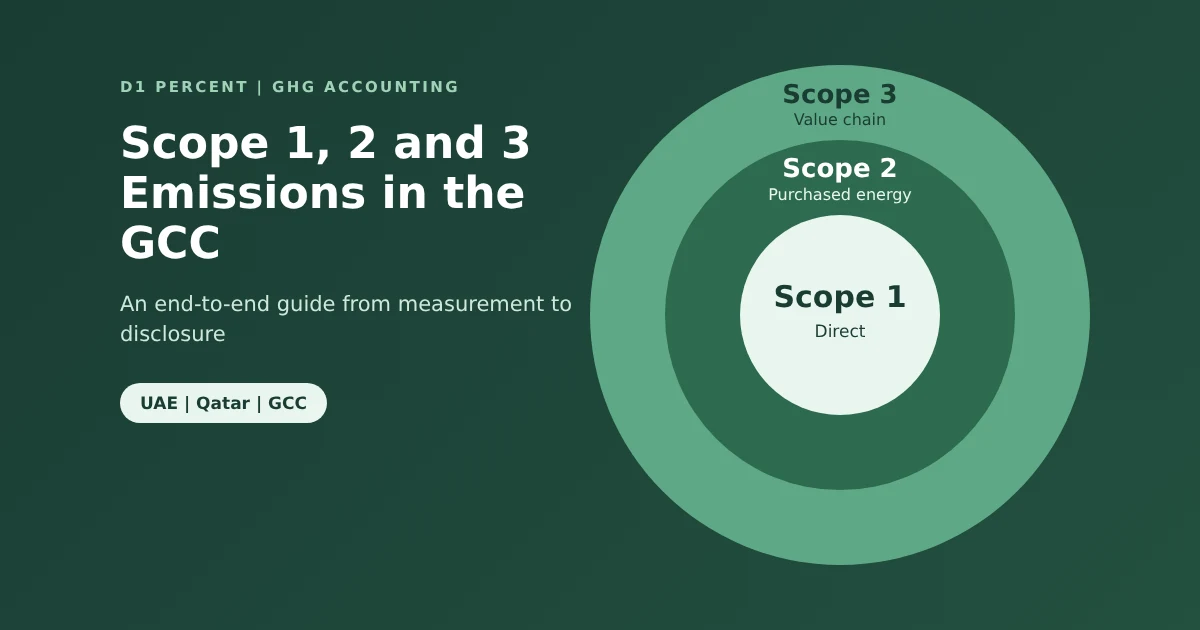
Scope 1, 2 and 3 are the three categories used to organise a company’s greenhouse gas (GHG) emissions. Scope 1 is what you burn or release yourself. Scope 2 is the energy you buy. Scope 3 is everything else in your value chain, from suppliers to customers. Whether you must report them depends on your regulator, your sector and your listing status, in the UAE, Qatar and the rest of the GCC.
Ask a finance team for last year’s revenue and you will get an answer in a day. Ask for last year’s emissions and the room goes quiet. That gap is closing. Greenhouse gas emissions reporting is moving from a voluntary extra to a data request from regulators, lenders, investors and large customers.
In the GCC the pressure comes from climate-related disclosure standards, the UAE’s federal climate law, Qatar’s financial-sector sustainability framework, investor questionnaires, supply chain data requests and national net-zero ambitions. The common thread is a number you can defend.
This guide explains the three scopes, shows how emissions are calculated, and sets out where GCC businesses stand on GHG emissions reporting in the UAE and Qatar, as part of wider corporate sustainability reporting. It separates legal requirements from guidance and voluntary practice, and it flags what to confirm with your regulator.
What Are Scope 1, 2 and 3 Emissions?
The scopes come from the GHG Protocol, the most widely used standard for corporate GHG accounting. They let companies count emissions the same way and avoid counting the same emission twice.
Emissions from sources your organisation owns or controls. If it burns fuel or releases gas on your site or in your vehicles, it is Scope 1.
- Fuel burned in company-owned vehicles
- Diesel generators
- Natural gas in industrial processes and boilers
- Process emissions from manufacturing
- Refrigerant leaks from air-conditioning and cooling, which matter in a hot climate
Emissions from generating the electricity, steam, heating and cooling you buy and use. The power station is not yours, but the demand is.
- Electricity in offices, factories and warehouses
- Purchased district cooling
- Purchased steam and heat
Emissions from your upstream and downstream value chain that are not in Scope 1 or 2. The GHG Protocol groups them into 15 categories.
- Purchased goods and services
- Transport, travel and commuting
- Waste and use of sold products
Scope 2 can be reported in two ways
Uses the average emissions intensity of the grid where the electricity is consumed.
Reflects the electricity you chose to buy, using contractual instruments such as certificates or supplier-specific factors, with a residual mix where nothing else is available.
The GHG Protocol’s Scope 2 Guidance asks companies in markets that offer contractual instruments to report both and label each result. The two figures are not added together.
The Scope 3 categories most businesses meet first
Fuel- and energy-related activities here means those not already in Scope 1 or 2. Scope 3 is harder than the other two because someone else holds the data. You depend on suppliers, customers and logistics partners, and their data may be partial, late or in a different format.
Scope 1 vs Scope 2 vs Scope 3: Key Differences
| Scope 1 | Scope 2 | Scope 3 | |
|---|---|---|---|
| What it measures | Direct emissions | Emissions from purchased energy | Other value chain emissions |
| Where emissions originate | Sources you own or control | The power or heat generation you pay for | Suppliers, customers, transport, waste, travel and more |
| Practical examples | Fleet fuel, generators, boilers, refrigerant leaks | Office, plant and warehouse electricity, purchased cooling | Purchased steel, business flights, use of sold products |
| Typical data needed | Fuel and gas use, refrigerant top-ups, process data | Electricity and cooling bills, meter data, supplier or certificate data | Spend data, supplier data, distance and weight data, product use data |
| Level of control | Highest | Moderate, through energy choices | Lowest, through influence and engagement |
Practical Examples for GCC Businesses
These examples are illustrative. They show where emissions typically sit and are not figures for any real company.
Manufacturing
Scope 1Fuel used in furnaces and generators.
Scope 2Purchased electricity for production facilities.
Scope 3Purchased steel and raw materials, transportation and waste.
Oil and gas
Scope 1Operational fuel combustion and fugitive emissions.
Scope 2Purchased electricity.
Scope 3The supply chain, processing, transportation and, where applicable, use of sold products.
Construction and real estate
Scope 1Fuel used by construction equipment and company vehicles.
Scope 2Purchased electricity in buildings and offices.
Scope 3Cement, steel, other materials, transportation and waste.
Banking and financial services
Scope 1Company vehicles and fuel.
Scope 2Electricity in offices and branches.
Scope 3Business travel, purchased services and, potentially, financed emissions.
Financed emissions are the emissions linked to loans and investments. They need their own accounting boundaries and are a distinct topic.
Understanding the three scopes is only the first step. Businesses also need a structured way to identify emission sources, collect activity data and assess their carbon footprint. To see how that process can be approached in practice, explore D1Percent’s illustrative Scope 1, 2 and 3 emissions assessment for a UAE manufacturer. It is a modelled example, not a verified client engagement, and its figures do not represent actual emissions from a real manufacturer.
How Do Businesses Calculate Scope 1, 2 and 3 Emissions?
A GHG inventory follows the same logic in every sector. The steps below align with the GHG Protocol Corporate Accounting and Reporting Standard.
- Define the boundariesDecide which entities you include (organisational boundary, by equity share or by control) and which emissions you count (operational boundary).
- Identify the emission sourcesList them in each scope.
- Collect activity dataLitres of fuel, kilowatt-hours of electricity, kilograms of material, kilometres travelled.
- Select emission factorsUse a documented, recognised source and record which year and version you used.
- Calculate the emissionsApply the formula below to each source.
- Assign each result to a scopeFor Scope 3, assign it to a category as well.
- Review data quality and assumptionsNote estimates and gaps.
- Document the methodologyPrepare the inventory so someone else could repeat it.
- Identify hotspots and reduction opportunitiesFocus effort where the emissions sit.
The basic formula
Here is an illustrative example. The factors below are placeholders for teaching, not real emission factors.
| Item | Activity data | Illustrative emission factor | Result |
|---|---|---|---|
| Scope 2: office electricity | 100,000 kWh | 0.40 kg CO2e per kWh | 40,000 kg CO2e, or 40 tonnes CO2e |
| Scope 1: generator diesel | 20,000 litres | 2.70 kg CO2e per litre | 54,000 kg CO2e, or 54 tonnes CO2e |
Assumptions: both factors are hypothetical, chosen to make the arithmetic easy to follow. In a real inventory you would use the current factor for your country, grid and fuel, from a source you can cite, and record it. Results are expressed in carbon dioxide equivalent (CO2e), which converts every greenhouse gas to a common unit.
For technical detail, the GHG Protocol publishes the Corporate Standard, the Scope 2 Guidance and the Corporate Value Chain (Scope 3) Standard. Our carbon accounting and GHG reporting support follows this approach.
Why Is Scope 3 Often the Biggest Challenge?
Scope 3 is where inventories stall, for reasons that have little to do with calculation:
Do not assume Scope 3 is automatically your largest category. The split depends on your industry, activities and value chain. For a bank, it often includes financed emissions. For a manufacturer, purchased materials. A screening exercise answers the question with data.
Scope 1, 2 and 3 Emissions Reporting in the UAE
GHG emissions reporting in the UAE is a mix of a federal climate law, capital market governance rules, supervisory expectations for financial institutions and voluntary practice. Not every company has the same obligations.
The federal climate law. Federal Decree-Law No. 11 of 2024 on the Reduction of Climate Change Effects has applied since 30 May 2025. It applies to emission sources, including those in free zones, and requires in-scope entities to measure, keep records of and report emissions. The law sets no size threshold. The Ministry of Climate Change and Environment (MOCCAE) or the competent emirate authority decides which sources report. Abu Dhabi runs a programme for facilities emitting 25,000 tonnes CO2e or more of Scope 1 emissions in covered sectors, and a separate Cabinet resolution applies to very large emitters above 0.5 million tonnes of Scope 1 and 2 emissions. Which scopes a given entity must report, and whether Scope 3 is in scope, should be confirmed against the current official rules. We found no formally published extension of the one-year adjustment period that ended on 30 May 2026, and implementing guidance is still emerging.
Listed companies. Companies listed on ADX or DFM follow the Capital Market Authority’s (formerly the SCA’s) Governance Guide, which advisers read as requiring an integrated report that includes sustainability reporting. Check your exchange’s current wording on emissions metrics.
Financial institutions. Banks and insurers face climate-related financial risk expectations from the Central Bank of the UAE. These are supervisory duties, not a general duty to publish an emissions report.
IFRS S2. IFRS S2 is the ISSB’s climate standard. It requires disclosure of Scope 1, 2 and 3 emissions, measured under the GHG Protocol Corporate Standard unless a jurisdiction requires another method, and it sets specific requirements for financed emissions. We found no instrument that makes IFRS S2 mandatory across the UAE, though some regulators and exchanges reference ISSB standards. The ISSB amended IFRS S2 in December 2025 with targeted reliefs, including for financed emissions, so check which version your regulator refers to.
Scope 1, 2 and 3 Emissions Reporting in Qatar
Scope 1, 2 and 3 emissions reporting in Qatar, and GHG emissions reporting more broadly, depends on who regulates you. Three regulators issue ISSB-based requirements, and they cover different entities.
The Sustainability Reporting Framework was issued on 4 December 2025. It is based on IFRS S1 and S2 and applies to financial years beginning on or after 1 January 2026, so the first report covers FY2026 and falls in 2027.
Companies listed on the Qatar Stock Exchange make annual ESG disclosures covering environmental indicators such as emissions, with climate-risk assessment aligned to ISSB standards and, for main-market companies, external assurance.
We found no general emissions-reporting rule for private companies outside these groups, but lenders, investors and large customers often ask for GHG data. A Scope 1 and 2 inventory is the usual first request.
Public summaries say Qatar extends two IFRS S2 reliefs by one year: the option to use a measurement method other than the GHG Protocol, and the option to omit Scope 3 emissions. These change timing and method, not the need for the data. Our guide to the QCB Sustainability Reporting Framework sets out the details.
Whether the QFMA Governance Code names specific emission scopes is something to confirm in its appendix. We did not review the Qatar Stock Exchange’s own ESG guidance, so check it for any metric expectations.
How Can GCC Businesses Prepare for GHG Emissions Reporting?
- Identify your organisational boundaries
- Map your operational emission sourcesAcross sites, fleets and cooling systems.
- Assign internal data ownersWith a backup for each.
- Collect electricity and fuel recordsFor every site.
- Gather supplier and procurement information
- Identify the relevant Scope 3 categoriesWith a screening exercise.
- Select recognised accounting methodsAnd write them down.
- Establish data collection and documentation processes
- Review the calculationsUsing a second person.
- Identify reduction opportunitiesFrom the hotspots.
- Prepare for future reporting requirementsBy keeping data in a form that can serve more than one disclosure.
Start with Scope 1 and 2 if you have no baseline, then screen Scope 3.
How D1 Percent Can Support GCC Businesses
D1 Percent is an ESG and sustainability advisory firm working with companies in the UAE, India, Qatar and the wider GCC. Our GHG and reporting support includes:
Frequently Asked Questions
What are Scope 1, 2 and 3 emissions?
They are the three categories of the GHG Protocol. Scope 1 covers direct emissions from sources you own or control. Scope 2 covers indirect emissions from purchased electricity, steam, heating and cooling. Scope 3 covers all other indirect emissions in your value chain.
What is the difference between Scope 1 and Scope 2 emissions?
Scope 1 emissions occur at sources you own or control, such as fuel burned in your vehicles or boilers. Scope 2 emissions occur where your purchased energy is generated, such as at a power plant.
Why is Scope 3 emissions reporting important?
For many companies Scope 3 is a large part of the footprint, and investors, lenders and customers increasingly ask for it. It also shows where reduction opportunities sit in the supply chain. Its size varies by sector.
How do businesses calculate Scope 1, 2 and 3 emissions?
They multiply activity data (such as litres of fuel or kilowatt-hours) by an emission factor, then assign the result to a scope and category, following the GHG Protocol steps in this guide.
Is Scope 1, 2 and 3 emissions reporting mandatory in the UAE?
Not as a universal rule. Federal Decree-Law No. 11 of 2024 requires in-scope emission sources to measure and report emissions, and MOCCAE or the emirate authority decides which sources and how. Listed companies follow CMA governance rules. We found no instrument that requires every company to report all three scopes. Confirm your obligations with the relevant authority.
What are the Scope 1, 2 and 3 emissions reporting expectations in Qatar?
QCB-regulated banks and insurers follow the QCB Sustainability Reporting Framework, based on IFRS S1 and S2, from financial years beginning on or after 1 January 2026. Listed companies follow the QFMA Governance Code. Other businesses face mainly lender, investor and customer expectations.
Which GHG accounting standard should businesses use?
The GHG Protocol Corporate Accounting and Reporting Standard is the most widely used, with its Scope 2 Guidance and Scope 3 Standard. IFRS S2 refers to it for measurement. If a regulator requires a different method, follow the regulator.
How can GCC companies prepare a GHG emissions inventory?
Set boundaries, name data owners, collect fuel and electricity records, document methods and keep evidence. Start with Scope 1 and 2, then screen and build out Scope 3.
Conclusion: Start With a Number You Can Defend
Scope 1, 2 and 3 emissions are the common language of corporate carbon accounting. In the UAE and Qatar, the rules that apply differ by regulator, sector and listing status, but the foundation does not: a repeatable inventory with clear boundaries, documented methods and a named owner for each number.
You do not need all three scopes on day one. You need a baseline you can explain, and one that feeds your corporate sustainability reporting.
D1 Percent can assess your readiness, measure your Scope 1, 2 and 3 emissions and prepare you for the disclosures that apply to you.
Contact D1 PercentThis article provides general information and is not legal advice. D1 Percent does not provide legal advice. Confirm your obligations with the relevant regulator and a qualified legal or regulatory specialist.
Sources and further reading
Standards and standard-setters
- GHG Protocol: Corporate Accounting and Reporting Standard
- GHG Protocol: Scope 2 Guidance
- IFRS Foundation: Qatar jurisdiction profile for IFRS Sustainability Standards
- Qatar Central Bank: Sustainability Reporting Framework